The Source map
The registry on a map: every park in your hunt, placed, with the record one click behind each pin.
Five free pilot places.
Seller claims, source evidence, site observations, unresolved diligence, and underwriting, connected in one workspace before you commit capital.

The rent roll, the P&L, and the bank deposits tell three different stories, and nobody owns the reconciliation. The rent roll is a claim, not income verification.
Water, sewer, electrical, and roads carry the real risk. A package may mention them without establishing permits, responsibility, or operating condition. The permits buyers skip.
Diligence lives in inboxes, photo folders, and memory. When the deadline moves, the truth moves with it. Before you underwrite the deal, establish what is true.
Capital commits only against what the record supports. What the record cannot prove does not get priced, and does not get paid for.
Chapter 1 · Source · Know it
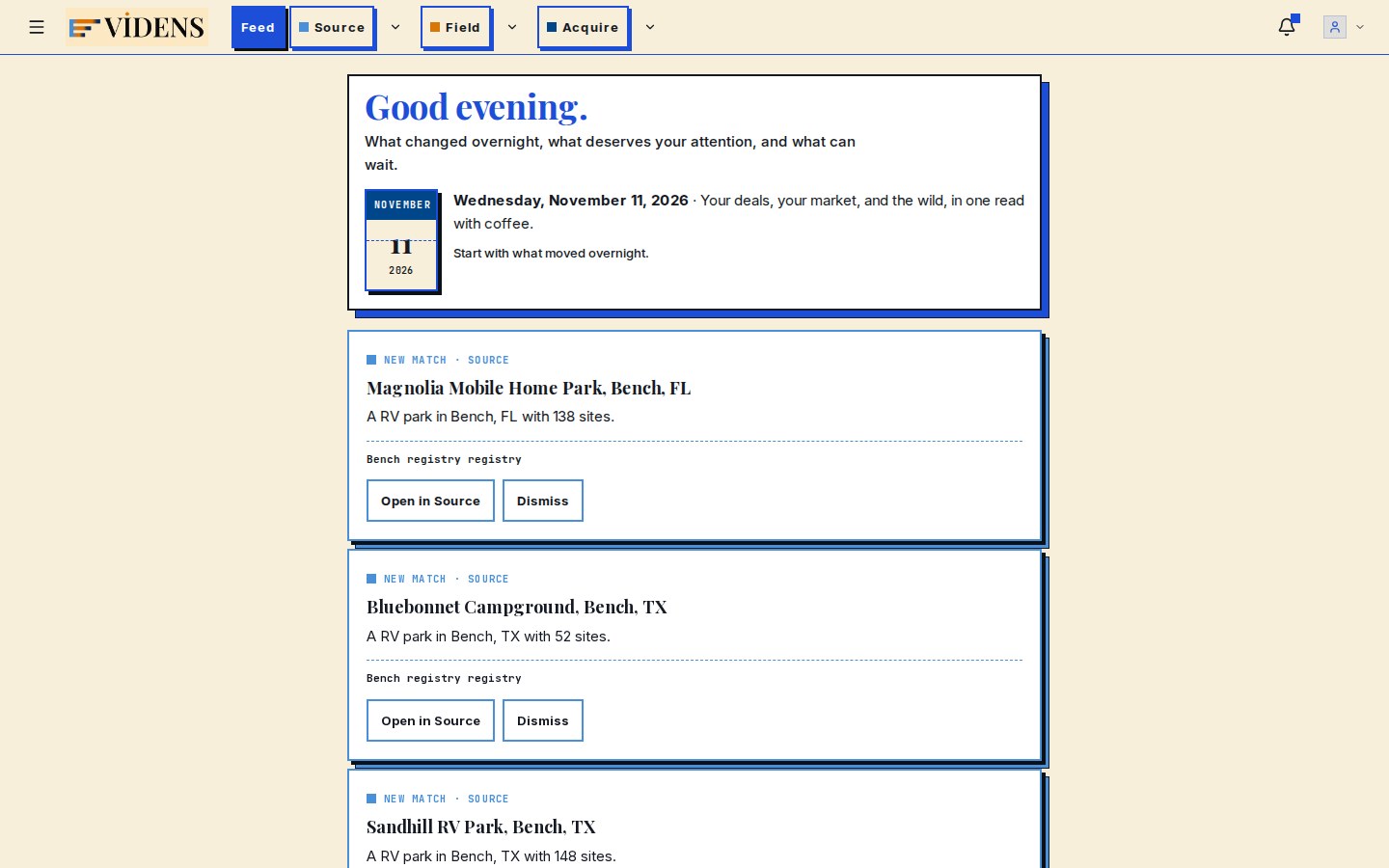
Never miss a park that fits. The doors open on the record, and the Feed keeps the hunt current while you work.
Source sees what the outside world says before you arrive. Public listings, public records, broker packages, and seller statements enter the record with their origins attached. Source builds the lead record with sourcing and enrichment around it. Source material is organized, never automatically trusted.
Over it, the Feed: arrivals that match your hunt land on the record with their source attached, so a new park reaches you as a record, not as a rumor in an inbox.

Chapter 2 · Source · Know it
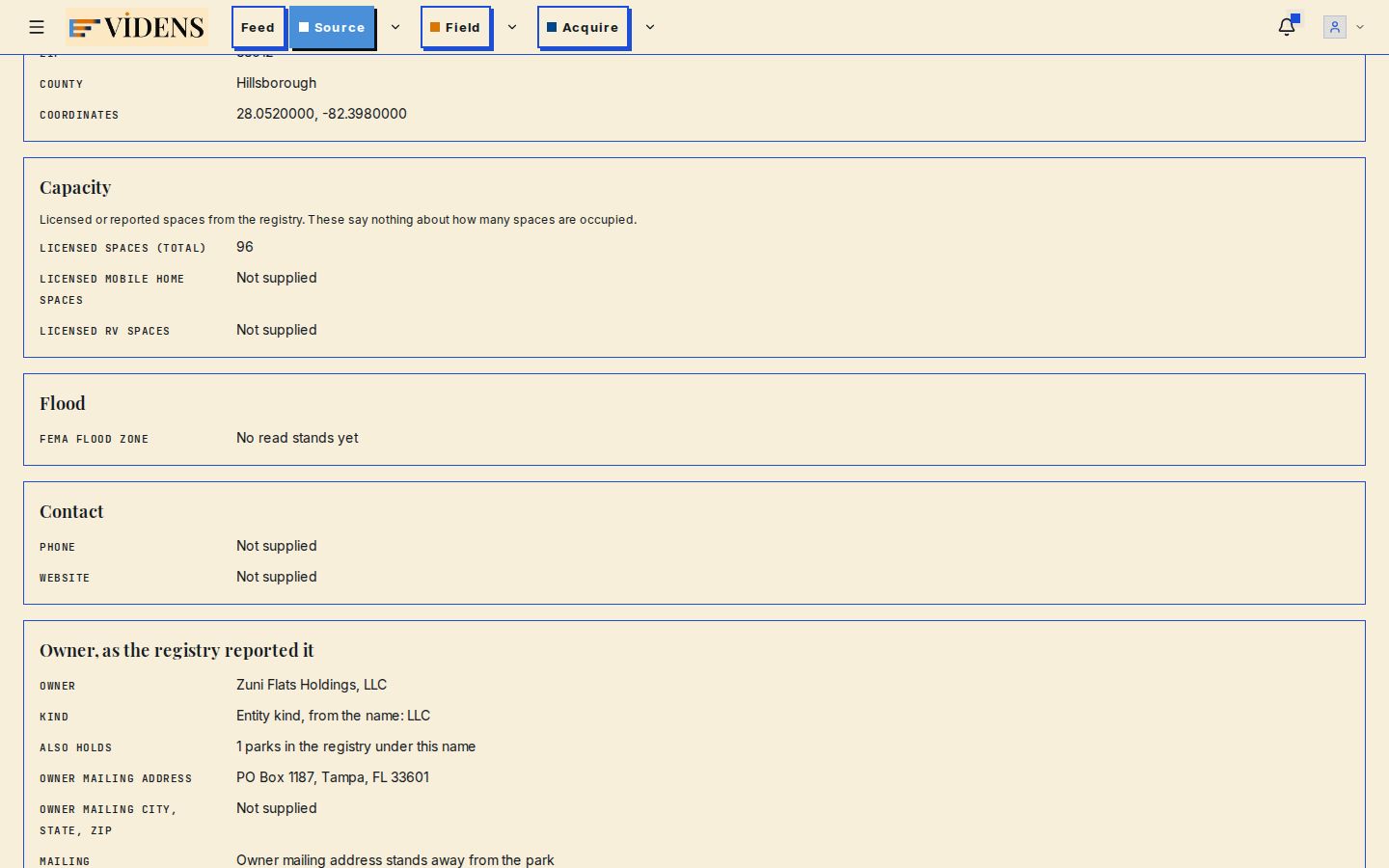
The Library is where a lead earns its morning. A table is the proof the product handles real volume.
Source organizes your broker packages, public records, and seller statements with provenance on every document you attach. Source sees what the outside world says before you arrive: organized, never automatically trusted. A lead that does not survive screening stays in the record with the reason attached.

Chapter 3 · Acquire · Know it
The Tray and the Lead Brief are the centrepiece: judgement and workflow, not storage. This is the longest chapter because it is the surface the decision is made from.
Assign each claim an evidence state using the ParkProof definitions: Verified, Broker-reported, Missing evidence, Underwriting assumption, Calculated, or Unresolved. You supply the supporting evidence and document your review; Evidens does not independently verify the claim.
The Lead Brief is the deal on one page: the claims, their states, the open gates, and the next action, rendered from the record itself. It is the page the decision gets made from, and it carries the park's aerial snapshot whenever it is opened.


The six evidence states (the Evidens ParkProof Standard):
| Evidence state | On this page, it means |
|---|---|
| Verified | Evidence you can point to, reviewed by a person. |
| Broker-reported | Claimed in the package or on a call; not checked yet. |
| Missing evidence | Material information not received or located yet. |
| Underwriting assumption | A stated input in your case; not a verified fact. |
| Calculated | Output from stated inputs; only as reliable as they are. |
| Unresolved | Sources conflict, or the answer is not established yet. |
Evidens does not assign these for you and does not independently verify a claim. You supply the evidence, you document the review, the record keeps both.
Capital commits only against what the record supports. What the record cannot prove does not get priced, and does not get paid for.
The standard every chapter on this page is held to
Chapter 4 · Field · Take it
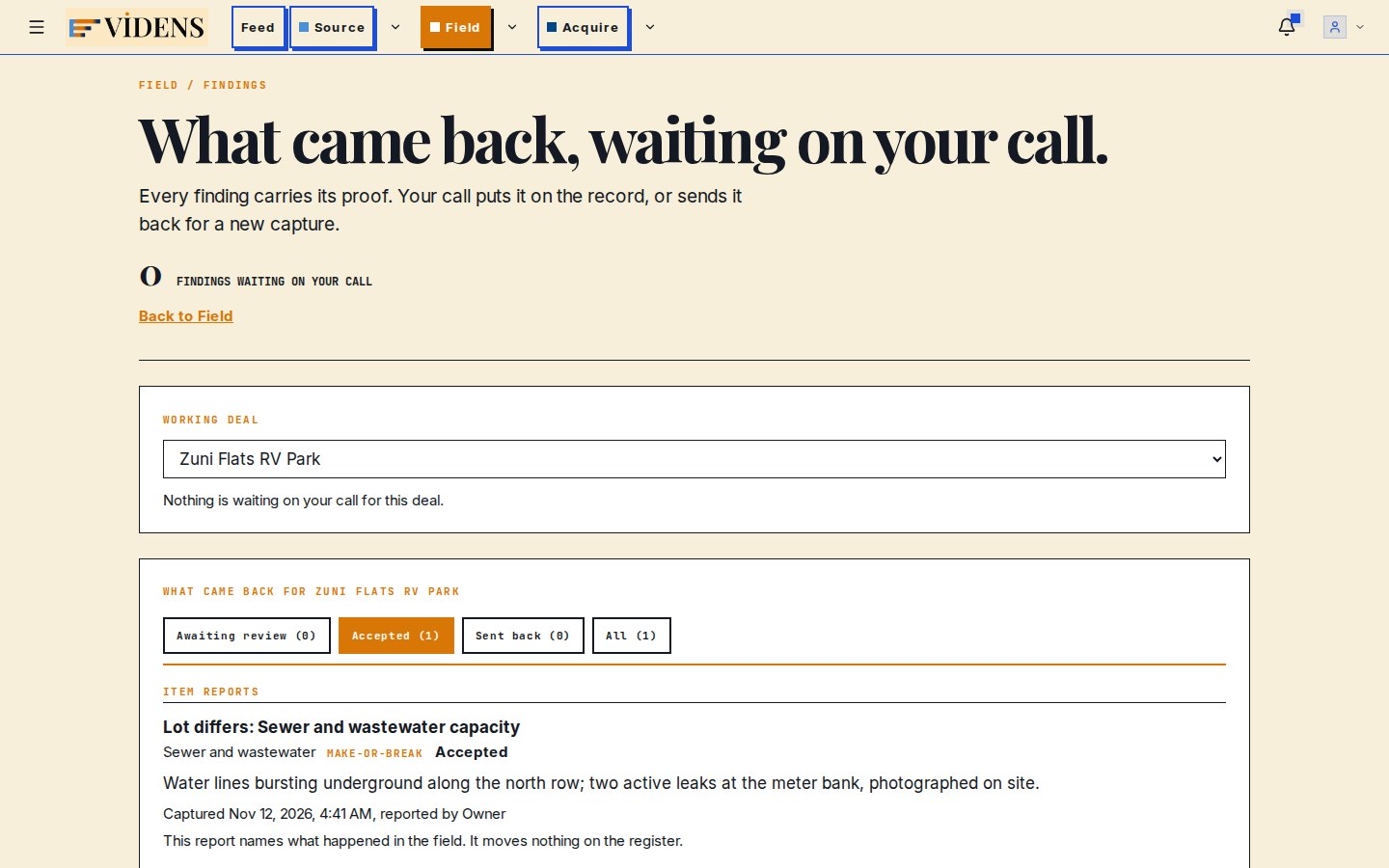
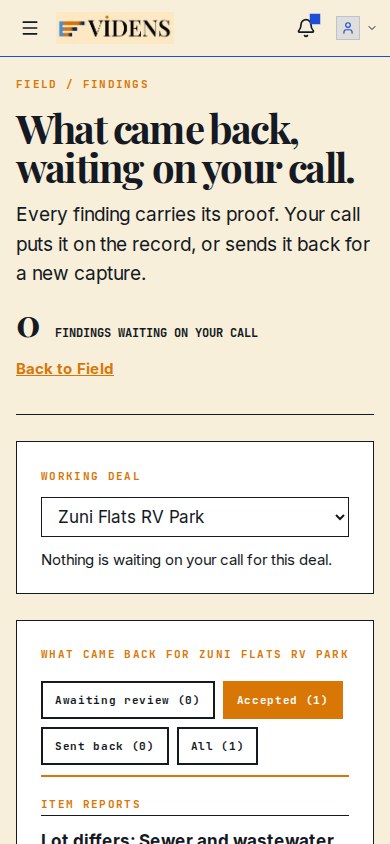
Field captures what you see when you get there. These are the screens used on site at a park, shown smaller, because that is the size they are worked at.
Field captures what you see when you get there. Photos, notes, and observations enter the record as unreviewed evidence until a person reviews them. On the site walk you record what the paper cannot show: utilities, wastewater, metering, roads, and site conditions. Captured is not verified.
Every capture is unreviewed evidence until you review it, and field evidence supersedes contradicted paper on the record, with the paper staying visible rather than deleted.
Chapter 5 · Acquire · Know it
Acquire organizes what either stream means. The Deal Desk prices only what the record supports; the register holds the decision to the standard.
The engine calculates only from assumptions you approve. Models may propose. You confirm. Code calculates.
Generate the ParkProof file from your reviewed evidence, unresolved gates, and approved assumptions. Take it to your partners, your lender, or your own investment committee. The posture is yours: advance, retrade, pause, or walk.


Buying a mobile home park? The record works the same way. Whether the sign out front says RV park, campground, or manufactured housing community (MHP), the standard does not change: claims are labeled, evidence is attached, and nothing counts as proven until the record proves it.
A manufactured housing acquisition runs two records at once.
The first record is the land: permitted sites, utility capacity, the age of the lines.
The second record is the homes: who holds each title, which homes are tenant-owned and which are park-owned, and what the lot rent actually deposits.
Evidens keeps both records in the one workspace, so seller claims, source evidence, site observations, and unresolved diligence stay connected across the land and the homes before capital commits.
Manufactured housing: the claims that carry an evidence state (Evidens Acquisition Workspace):
| The claim | What the record holds |
|---|---|
| Home title status | Every home counted from its title: park-owned outright, park-owned with a lien, or resident-owned. A home whose title cannot be located is missing evidence, not a rounding error. |
| Tenant-owned vs park-owned split | The mix stated home by home, each side priced on its own evidence. Until the titles are counted, the split is broker-reported. |
| Utility ownership and metering | Who owns each system, who pays for it, and how it is metered: master meter, sub-meter, or resident account. Capacity claims stay unresolved until permits or bills establish them. |
The states are the same six. What changes in manufactured housing is which claims carry the deal.
The deal does not advance on open gates. It advances on verification, or on a waiver somebody signed their name to.
The chapters above are the loop. These are the surfaces around it, named by the job they do.
The registry on a map: every park in your hunt, placed, with the record one click behind each pin.
The Lead Brief before promotion: the brief renders against the candidate, so the promote decision is made on the record, not on the listing.
An operator claims their park's record and corrects its face. A claim grants standing, not verification; corrections stand as owner-reported until the evidence moves them.
The generated file: documented posture, the evidence register, open gates, and calculation lineage, in the order a lender or partner reads.
I'm opening five free pilot places before charging for access. I need active buyers to use the workspace on real acquisitions and tell me where the workflow fails.
The trade
Run one live acquisition through Source, Field, and Acquire for 90 days from activation. No payment required and no automatic conversion.
In exchange, use the workspace and give candid feedback about what works, what breaks, and what is confusing. I troubleshoot software behavior, not your deal. Testimonials are optional and require separate written permission.
The file you build is built for a lender's or partner's read: claims, evidence, and open items in one place, each carrying its evidence state.
Apply for a free pilot placeAcceptance reserves a place. Your 90-day term begins when access and onboarding materials are delivered. Your acquisition timeline must allow you to begin using the workspace after your confirmed activation date.
Monthly buys the whole system, not a piece of it: Source, Field, Acquire, and the Feed, connected around one deal record.
Monthly Workspace $299 | Single-Deal $1,299 | Annual $2,999
and five free pilot places.
A deal worked on the record is built to reach closing with its open items already decided, not discovered.
Weighing the workspace against the data room your deal team already uses? The comparison is direct, data room vs due diligence software, side by side: what each one does with a claim.
Tell me your asset type, deal stage, and decision deadline. No documents or call required to submit. If the fit looks right, we'll arrange the next step.
Pick a time that works. You will get a calendar confirmation with the call details.
Prefer to talk first? Book an optional fit call.
Submitting an application does not reserve a place or begin access. We'll confirm acceptance and your activation date separately.
ParkProof Walkthrough / Illustrative record
One deal, walked all the way down.
Harbor Pines is fictional. The habit is not. Walk the deal claim by claim, source by source, every claim carrying its evidence state, until the record says what it can support and names what it cannot. One gate refuses to close, and the record holds at Pause.
See an illustrative ParkProof decision recordQuestions

Evidens
Acquisition Workspace